
A round on the Western Cape coast might run through Atlantic dunes near Cape Town, beside an Overberg lagoon or along an exposed Garden Route cliff. Ocean wind changes the game on all three, but the hazards and the ground beneath your feet are quite different.
An ocean view does not make a course a traditional links. The differences between a cliff-edge resort, a flat seaside club and a lagoon estate run beyond scenery: check walking distances, forced carries, visitor access and tee-time rules.
Coastal golf courses at a glance
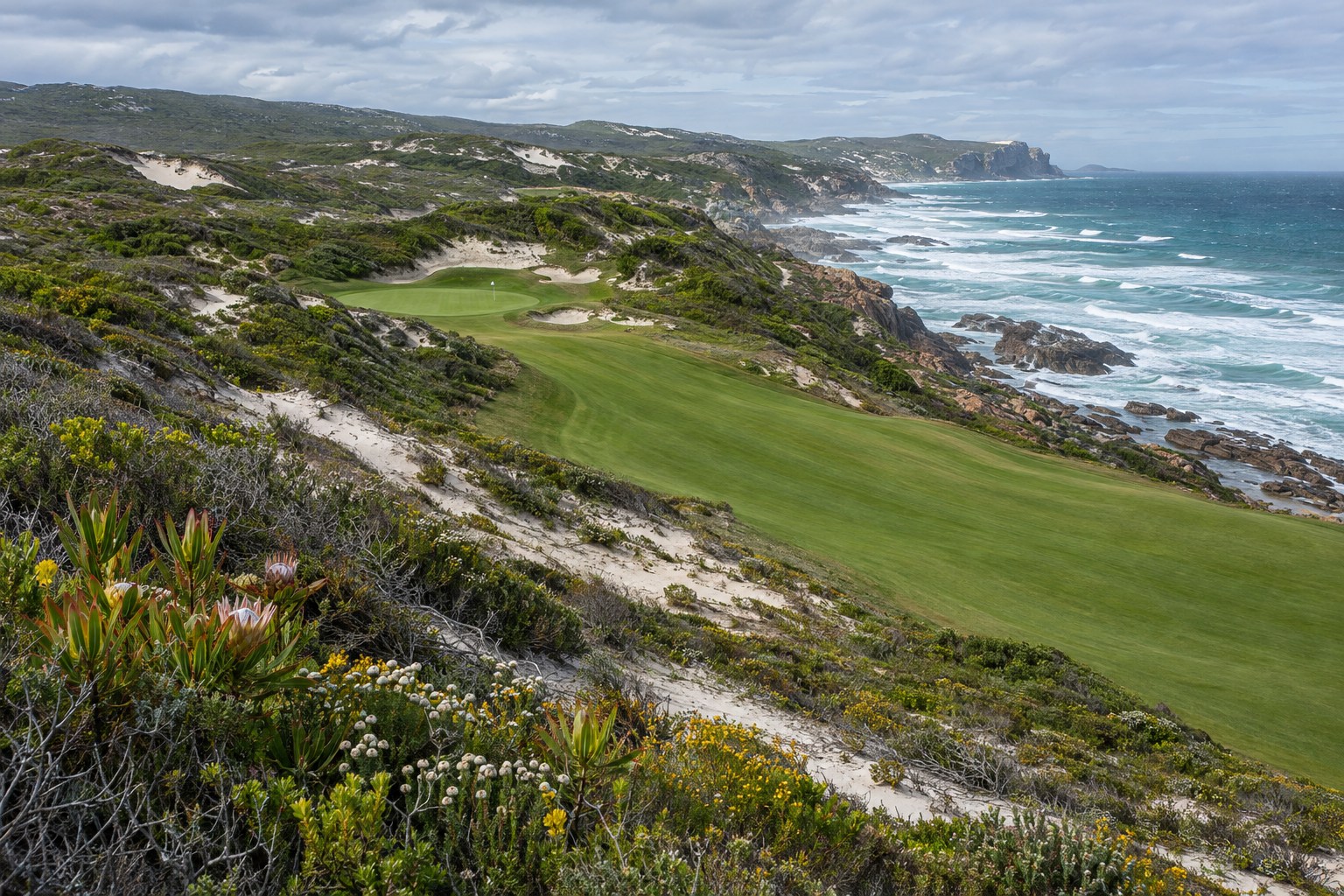
Coastal courses occupy three settings: oceanfront or clifftop, coastal dunes and seaside towns, and lagoon or estuary landscapes. “Links-style” describes elements of the design; it does not guarantee fairways directly on the beach.
| Course | Area | Layout | Distinctive setting |
|---|---|---|---|
| Atlantic Beach Links | Melkbosstrand, Cape Town | 18 holes | Coastal dunes, fynbos and Atlantic views |
| Milnerton Golf Club | Milnerton, Cape Town | 18 holes | Between the Atlantic Ocean and Diep River |
| Metropolitan Golf Club | Green Point, Cape Town | 18-hole round on a compact footprint | Urban seaside golf with Table Mountain views |
| Simon's Town Country Club | Simon's Town, False Bay | Nine-hole footprint; 18-hole play | Links-style golf on the Redhill slopes |
| Langebaan Country Estate | Langebaan, West Coast | 18 holes | Estate golf near the lagoon and national park |
| Shelley Point Country Club | St Helena Bay, West Coast | Nine holes with alternative tees | Links-style bunkering in a coastal estate |
| Kleinmond Golf Club | Kleinmond, Overberg | Nine holes with 18 tees | Sea views, mountains and Cape fynbos |
| Arabella Golf Course | Bot River Lagoon, Overberg | 18 holes | Lagoon-edge championship golf |
| Hermanus Golf Club | Hermanus, Whale Coast | 27 holes | Mountain foothills, wetlands and distant sea views |
| Pinnacle Point Golf Club | Mossel Bay, Garden Route | 18 holes | Ocean cliffs and exposed carries |
| Mossel Bay Golf Club | Mossel Bay, Garden Route | 18 holes | Indian Ocean views from every tee |
| Oubaai Golf Club | Herolds Bay, Garden Route | 18 holes | Links-style fairways overlooking the Indian Ocean |
| Pezula Championship Course | Knysna, Garden Route | 18 holes | Clifftop terrain above the ocean and lagoon |
| Knysna Golf Club | Knysna, Garden Route | 18 holes | Tidal inlets and lagoon-side fairways |
| Goose Valley Golf Club | Plettenberg Bay, Garden Route | 18 holes | Sand-dune terrain and Keurbooms Lagoon views |
Cape Town and the Atlantic coast: dunes, wind and city golf
Atlantic Beach Links, Melkbosstrand
The 18-hole Atlantic Beach Links at Melkbosstrand winds through coastal dunes and indigenous fynbos. Views take in Table Mountain, Robben Island and the Atlantic Ocean. It plays links-style golf without promising firm, running turf on every hole. Wind changes club choice and ball flight on the exposed fairways; there are no dramatic cliff-edge carries.
Milnerton Golf Club, Milnerton
Between the Atlantic Ocean and the Diep River, near Woodbridge Island, Milnerton Golf Club has a fairly flat, walkable 18-hole par-72 course. Its outward and inward nines run past water and open fairways. On a windy day there is little shelter, even though the terrain is gentle. Sea-side tees, lagoon margins and Table Mountain views make this a different test from a hilly resort.
Metropolitan Golf Club, Green Point
Nine fairways, 14 separate greens and alternative tees give Metropolitan Golf Club its compact 18-hole format. The course lies by Green Point Urban Park and Cape Town Stadium, near Mouille Point. Mark Muller redesigned it before its 2010 reopening. Table Mountain and Signal Hill frame the scene, and the last par three crosses water. It is easy to walk without devoting the day to a transfer outside Cape Town.
Simon's Town Country Club, False Bay
On the slopes of Redhill above False Bay, Simon's Town Country Club retains an older, informal links-style character. The club publishes nine holes and offers nine- or 18-hole rounds. Wind comes into play, and the southern Cape Peninsula location feels like a local club rather than a large resort.
West Coast golf: lagoon country and compact seaside layouts
Langebaan Country Estate, Langebaan
The 18-hole Black Knight Design course at Langebaan Country Estate is a Gary Player Designs layout near Langebaan Lagoon and West Coast National Park. Bunkers, water features, natural rock and birdlife give this estate round its character. The fairways are not on the beach. With several tees and practice facilities, mixed-ability groups can stay together.
Shelley Point Country Club, St Helena Bay
At Shelley Point, near St Helena Bay, Shelley Point Country Club has nine holes and alternative tees for an 18-hole round. Pot bunkers, fairway bunkers and coastal wind give the estate course its links-style challenge. The fairways do not run along the shoreline.
Overberg and Whale Coast: fynbos, lagoons and mountain views
Kleinmond Golf Club, Kleinmond
Kleinmond Golf Club occupies the Overstrand area of the Kogelberg Biosphere. Nine physical holes and 18 tees allow a full round without 18 separate fairways. Mountains, wildlife, sea views and indigenous Cape fynbos surround the course. The breeze reaches these natural fairways; this is local club golf rather than a large championship resort.
Arabella Golf Course, Bot River Lagoon
Beside the Bot River Lagoon, Arabella Golf Course is an 18-hole par-72 championship design by Peter Matkovich. Water, bunkers and Kogelberg fynbos shape the holes. The eighth is a notable par five; the eighteenth makes a demanding finish. Arabella is lagoon golf, not an oceanfront cliff course. The water hazard here sits closer to the fairway than the precipitous drops at Pinnacle Point.
Hermanus Golf Club, Hermanus
Visitors to Hermanus Golf Club can choose among 27 holes arranged in different 18-hole combinations. The layout lies below the Klein River Mountains, with shaped fairways, trees, water hazards, bunkers and sea glimpses from higher ground. Hermanus is on the Cape Whale Coast near Walker Bay, but the club itself does not meet the shoreline. December and January are busy, and the club publishes specific visitor booking windows for peak periods. The third nine is useful when playing again.
Garden Route: the Western Cape's most dramatic ocean golf
Pinnacle Point Golf Club, Mossel Bay
Above the Indian Ocean near Mossel Bay, Pinnacle Point Golf Club follows the cliffs for seven holes. Four involve shots across ocean or cliff terrain. Peter Matkovich and Darren Clarke designed the 18-hole, par-72 course through indigenous fynbos. Long drops and wind make the forced carries demanding, especially from the back tees. A shorter tee can be a better choice than the most ambitious one.
Mossel Bay Golf Club, Mossel Bay
Mossel Bay Golf Club is known for its claim that you can see the sea from every tee. The walkable 18-hole, par-72 links-style layout has undulating greens and Indian Ocean views. Its downhill par-five seventeenth heads towards the coast and plays harder into a sea breeze. Springbok may appear on the fairways. Visitors can book, although club competitions affect tee times.
Oubaai Golf Club, Herolds Bay
Near Herolds Bay and George, Oubaai Golf Club has 18 par-72 holes designed by Ernie Els. Broad fairways, bunkers, doglegs and multiple tee positions suit a range of players. The par-three seventeenth faces the Indian Ocean; the Outeniqua Mountains and Gwaing River Valley frame other views. Golfers based in George can get a coastal championship round here without travelling to Knysna.
Pezula Championship Course, Knysna
High above Knysna Lagoon and the Indian Ocean, Pezula Championship Course crosses steep, undulating fynbos terrain. Ronald Fream and David Dale designed the par-72 routing; the thirteenth and fourteenth are among its signature holes. Carts are compulsory under the published arrangements. With the halfway stop, a round can run close to five hours. That matters when mobility is limited or the next appointment is tight.
Knysna Golf Club, Knysna
Tidal channels, pools and other water hazards affect 12 holes at Knysna Golf Club. Beside Knysna Lagoon at sea level, the walkable 18-hole, par-72 course mixes links and parkland traits. The par-three eighth finishes at an island green. Flat fairways do not make the approaches simple, especially with a crosswind.
Goose Valley Golf Club, Plettenberg Bay
Goose Valley Golf Club in Plettenberg Bay was designed by Gary Player and occupies sandy ground above Keurbooms Lagoon. The 18-hole, par-72 course looks towards the Indian Ocean, Robberg Peninsula and Tsitsikamma Mountains. Indigenous trees, fynbos and birdlife border the holes. Sandy soil helps the course drain after rain, useful during the Garden Route's wetter spells.
What makes a coastal course the right choice?
Ocean cliffs, links-style fairways and lagoon golf are different tests
Clifftop golf brings steep ground and forced carries at Pinnacle Point and Pezula. Links-style golf takes different forms at Atlantic Beach, Milnerton, Mossel Bay, Oubaai and Shelley Point; the label does not mean every hole runs along a beach or plays on traditional links turf. With Lagoon golf, water and wetland edges come into play at Arabella, Knysna and Goose Valley.
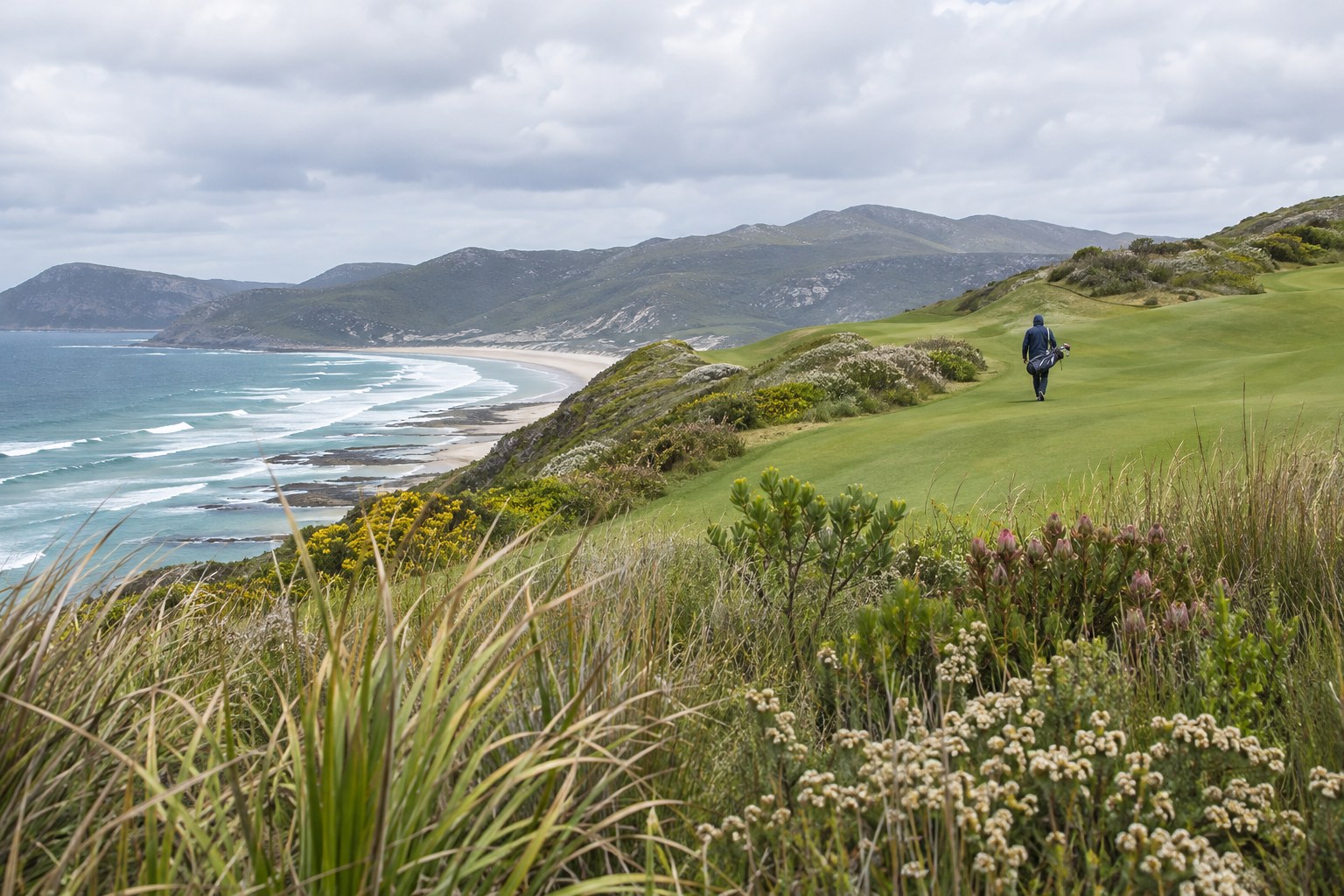
For ocean views, Mossel Bay, Pezula and Pinnacle Point have the stronger case. Water hazards play a greater strategic role at Milnerton, Arabella and Knysna. The easiest walk is not necessarily the most scenic round.
Match the layout to the player, not just the photograph
A short par three can demand a long iron into a coastal wind. At a cliff-edge course, the carry from your particular tee is the number to check. Beside lagoons, crosswinds bring water into the equation; in dunes, the approach may come from an uneven lie. Shorter tees leave the character of the course intact without making every carry an ordeal.
Milnerton, Mossel Bay and Knysna are practical walking courses. Pezula's steep layout requires a cart. At Kleinmond and Shelley Point, 18-hole play means using alternative tees on nine physical holes. Metropolitan offers 18-hole play on a compact site of its own. An “18 holes” booking does not always mean 18 separate fairways.
Visitor fees, affiliations and tee-time rules
South African green fees often distinguish affiliated from non-affiliated golfers, and some clubs ask for an official South African handicap. Cart hire, club rental, caddies, halfway meals and environmental levies may add to the quoted rate. The amount payable for the full round is more useful than a headline green fee.
Visitor access changes with competitions and season. Mossel Bay lists competition days; Metropolitan allows visitors on specified days, and Hermanus has separate standard and peak-period arrangements. Smaller clubs may have limited carts. Check the total price and permitted tee time for the intended date, plus cancellations, dress rules and course conditions.
When to play coastal golf in the Western Cape
Cape Town and the West Coast have a Mediterranean-type climate. Summers are generally drier, yet the south-easterly Cape Doctor can make exposed fairways difficult. Winter often brings rain-bearing fronts and north-westerly winds. The weather between morning and afternoon can change markedly, so gusts and wind direction deserve as much attention as temperature.
The Garden Route receives rain during much of the year, rather than following Cape Town's pronounced winter-rainfall pattern. Recent rainfall, drainage and forecast gusts offer better guidance for a round than the season alone. At Goose Valley, sandy soil helps the course recover after wet weather.
Whale Coast visits around Hermanus and Kleinmond can coincide with southern right whales in the bays during winter and spring, from midyear into spring. No sighting is guaranteed from a golf course. Hermanus Golf Club offers only occasional sea views, not an oceanfront whale-watching platform.
How to combine coastal rounds without exhausting the trip
Cape Town and the Peninsula: Atlantic Beach and Milnerton are a natural Atlantic-side pair. Metropolitan fits a day in the city; Simon's Town means a change of scenery at False Bay. Clovelly Golf Club, near Fish Hoek, lies in the Silvermine valley rather than on the beach.
Overberg and Whale Coast: Kleinmond has nine physical holes, Arabella offers championship golf beside a lagoon and Hermanus has 27 holes. All three fit a stay around Kleinmond or Hermanus, with Walker Bay nearby.
Garden Route: Pinnacle Point and Mossel Bay Golf Club offer very different rounds in one town. Oubaai works from George. Pezula and Knysna Golf Club contrast elevated and sea-level play; Goose Valley lies farther east at Plettenberg Bay. Allow for transfers and changing wind when booking consecutive days.
Not every well-known Western Cape golf course is coastal. The Links at Fancourt near George has links-style golf away from the ocean; Simola overlooks inland Knysna scenery. Steenberg, De Zalze and Pearl Valley also occupy different landscapes. The design label and the coastline are separate things.
On the same trip, a clifftop carry at Pinnacle Point can test nerves while an approach at Arabella or Knysna brings lagoon water into play. At Milnerton, the Atlantic crosswind may be the greater problem. The forecast and the right tees matter more than an ocean photograph.