
Milnerton Golf Club occupies a narrow stretch of Cape Town coastline between the Atlantic Ocean and the Diep River-Rietvlei Lagoon system. Its 18-hole layout combines open seaside golf, water-lined fairways and views across Table Bay to Table Mountain. The ground is relatively flat, but the exposed setting creates a challenge that cannot be judged by distance alone: a calm round can feel approachable, while a strong south-easterly turns club selection, trajectory and control into the main tests.
The course sits on Bridge Road near Woodbridge Island and Milnerton Lighthouse.
What kind of golf course is Milnerton?
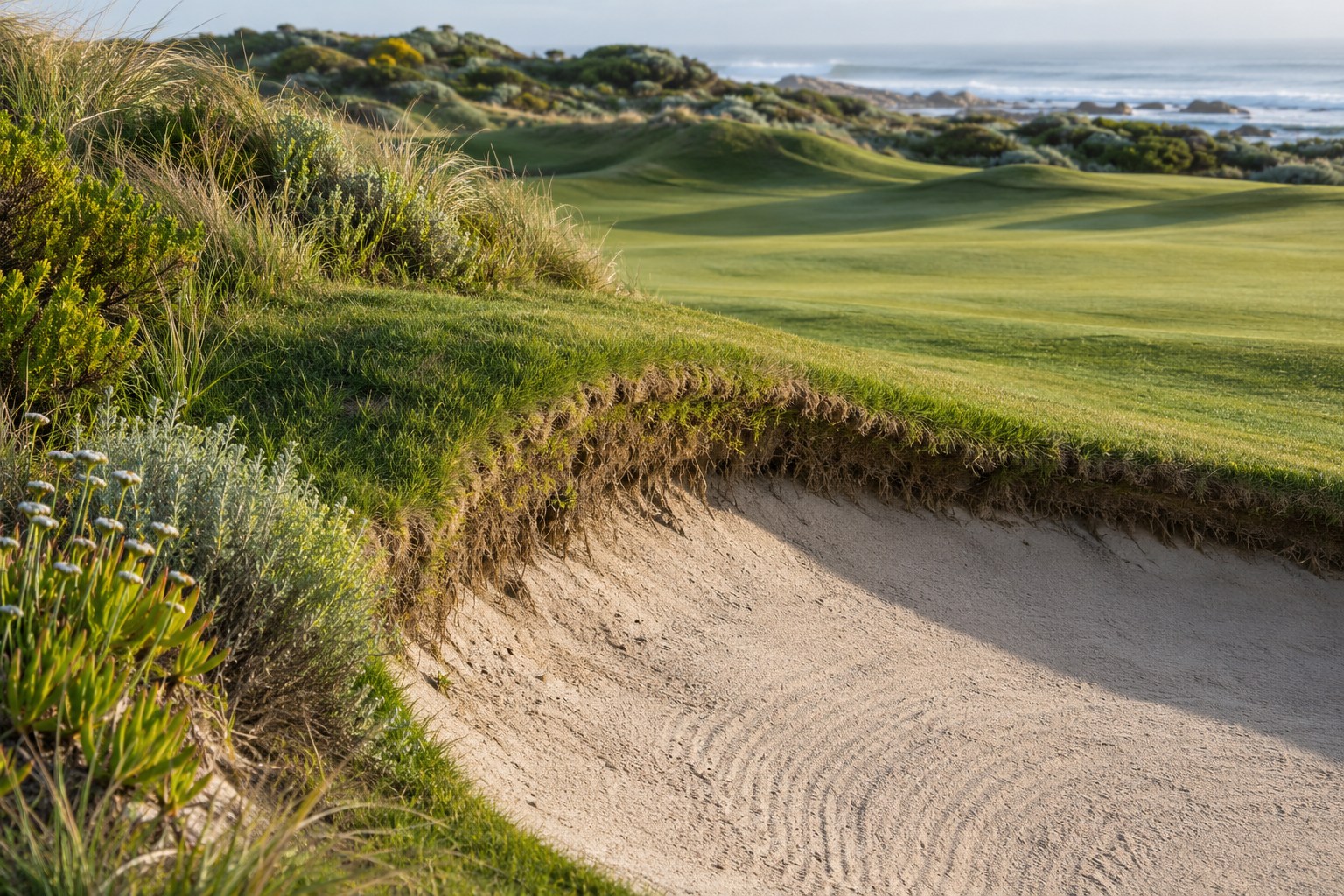
Milnerton is best described as a coastal links-style course. The Atlantic lies to the west, with the lagoon, wetlands and Diep River along the inland side. Sandy ground, salt air, few trees and exposure to wind give parts of the layout a strong links character. The fairways are flatter and less dune-shaped than those on a traditional Scottish links, and several inland holes have a more parkland-like feel.
The club publishes an 18-hole, par-72 course measuring approximately 6,101 metres in its general description. That figure is a useful orientation rather than a distance for every player: tee colour, course configuration and the current scorecard determine the length actually played. An unusual detail explains why golf apps sometimes list Milnerton as par 71. The sixth is a par five for competition play but is shortened to a par four on other days. A scorecard showing par 71 need not indicate a different golf course.
The routing follows the classic nine-out, nine-in pattern. The opening nine travels away from the clubhouse towards a halfway house; the back nine returns along the lagoon-side corridor. It is an easy course to understand on a map, yet its narrow strip of land leaves limited room for recovery after a poor line off the tee.
Where the design creates the biggest challenge
Milnerton's defining hazards are not extreme changes in elevation. They are the wind, exposed approaches, sloping greens, greenside bunkers and water close to the intended line of play. The club identifies seven water holes. The sea is also part of the setting, although beach and environmentally sensitive coastal areas should not be treated as ordinary playing ground.
Opening holes: wide views, limited protection
The first hole is a 363-metre par four from the yellow markers. The first and eighteenth fairways form a broad shared-looking corridor, which can make the opening drive appear forgiving. By the third and fifth tees, the shoreline is especially close. An exposed tee shot calls for careful alignment even when the fairway looks generous.
The seventh and eighth: wind and wetlands
The seventh is a short par three, listed at 134 metres from the yellow tees. Its modest yardage conceals the effect of the Cape Doctor: into a strong breeze, the same flag can demand a much longer club than it does on a still day. The eighth, a 475-metre par five from yellow, is one of the course's most distinctive holes. Wetlands border the left, a hazard tracks the right, and water protects the right side of a narrow green. Longer hitters may consider reaching in two, but the safer route is often a controlled lay-up that leaves an approach from a comfortable distance.
The ninth and twelfth: accuracy before power
The par-four ninth carries stroke index one on the club's published hole details, with water in front of the green near the turn. The twelfth is another demanding par four, measured at 380 metres from yellow. A headwind makes it play longer, while bush to the right and out-of-bounds beside the neighbouring residential estate to the left punish an ambitious or poorly directed drive. Position on the fairway matters more than simply hitting the ball as far as possible.
The homeward stretch
Water shapes the approaches at the thirteenth and fifteenth, while greenside bunkers become a particular concern at the par-three fourteenth. Holes sixteen to eighteen run back alongside the Rietvlei waterway: a shorter par four, a reachable par five and a substantial closing par four. The eighteenth returns players towards the clubhouse with Table Mountain back in the picture. A round that starts with a helpful wind can finish with the toughest ball-striking of the day.
How Cape Town's weather changes the course
The prevailing summer south-easter, known locally as the Cape Doctor, is central to golf in Milnerton. The outward nine often plays with more wind assistance and the return nine into it. Wind direction and strength change, so a fixed club choice based on the scorecard alone is unreliable. A lower ball flight, extra attention to crosswinds and a less aggressive target near water are practical responses when the breeze strengthens.
The ground underfoot tells another part of the story. Milnerton is built on a sandy base with relatively good natural drainage, an advantage during the Western Cape's wetter winter months. The club lists Kikuyu fairways and a Poa-Bentgrass mixture on the greens. Sloping putting surfaces reward pace control; a shot that finds the green can still leave an awkward putt or run away from the intended target.
Dry-looking turf does not guarantee an effortless round, and drainage does not rule out weather interruptions. Coastal mist can restrict visibility, exposed greens can become demanding in strong wind, and winter rain still affects playing conditions. Coastal erosion has also required attention near parts of the ocean-facing holes. Current tee positions and local course notices matter more than older GPS maps when a section has been altered.
Scenery, wildlife and the character of the setting
The scenery is unusually close to the golf. The Atlantic surf is audible from much of the course, while Table Mountain, the Cape Town skyline and Table Bay provide a changing backdrop. On clear days, Robben Island is visible in the distance. Milnerton Lighthouse and the Woodbridge Island shoreline reinforce the feeling of playing on the edge of the city rather than at an inland estate course.
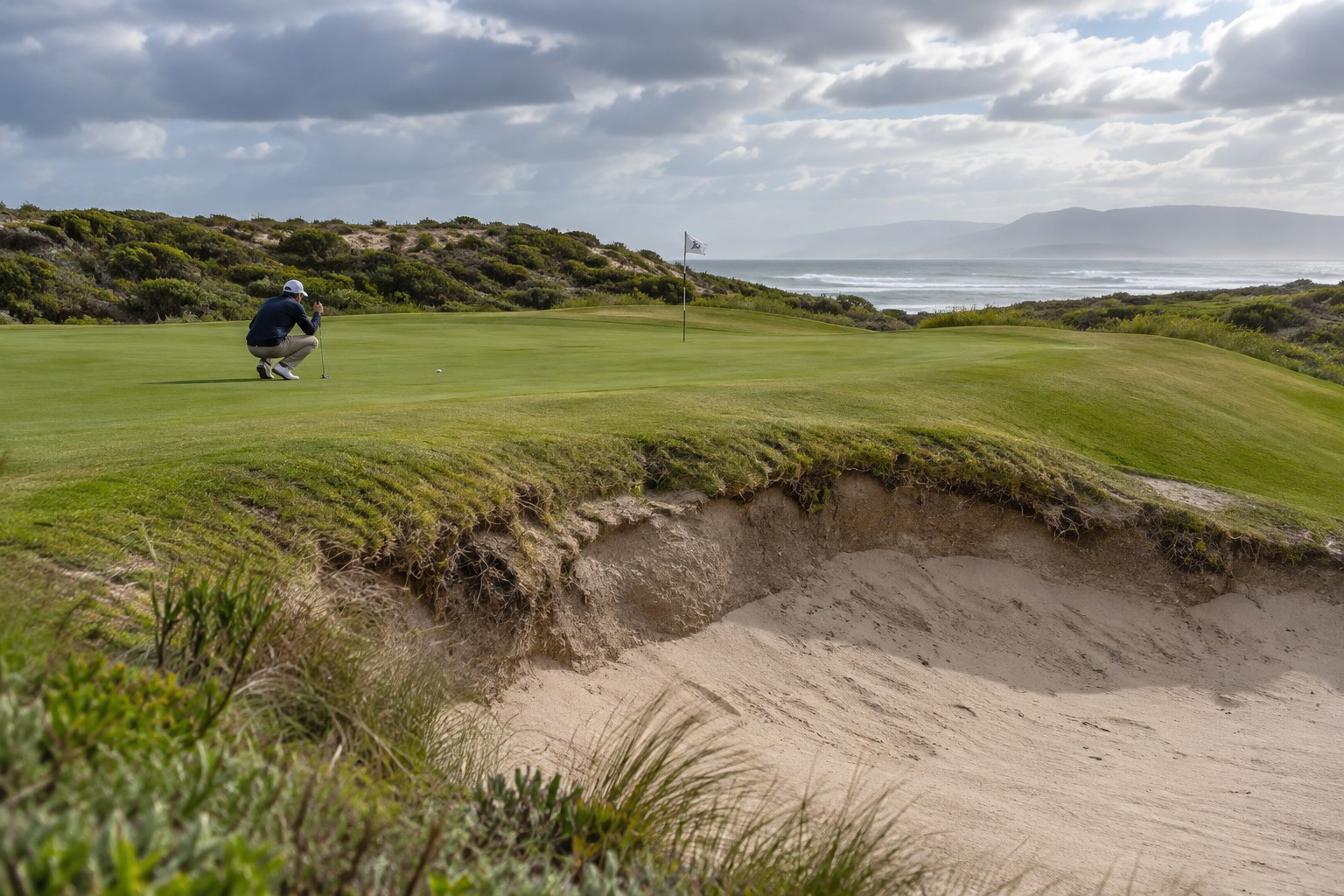
The lagoon and surrounding wetland habitat attract waterbirds, adding a different character to the inland holes. The setting also places the course beside sensitive coastal and aquatic environments. Balls entering water or protected vegetation should be dealt with under the applicable local and Rules of Golf procedures, not retrieved at the expense of safety or habitat.
Practice facilities, coaching and clubhouse amenities
The on-course driving range sits between the third and seventeenth fairways. The club's range information lists a 07:30 opening and 17:30 closing time; operating arrangements can change with daylight and facility management. The range is associated with Legacy Golf Range and PGA teaching professional Arno Marais. It provides a place to work on ball flight before a round on the exposed fairways.
Short-game preparation is supported by a putting green, a chipping green and three practice bunkers. Practising a low approach and a controlled bunker escape is particularly relevant when the wind is up and the greens are firm or fast.
Milnerton Golf Club also has a pro shop offering equipment and assistance with club hire, golf carts, caddies and other playing arrangements. Pull trolleys are among the options described in course overviews. Changing rooms provide showers and towels. A halfway house serves the outward-and-return routing, while the clubhouse's dining and lounge areas look towards the ocean. The view from the nineteenth hole is a feature in its own right, especially near sunset.
The layout is comparatively flat and suitable for golfers who prefer walking, although a full 18 holes is still a substantial outing in coastal wind. Cart availability, hire equipment and caddie arrangements should be treated as booking-specific rather than guaranteed on arrival.
What visiting golfers need to know
Visitor play is available, but tee-time access is not unrestricted. The club reserves Wednesday afternoons, Saturdays, Sunday mornings and public holidays for members or member-priority play. Its published visitor arrangements also describe a nine-hole sundowner option from 15:30 on selected weekdays and Sundays, subject to golf-day commitments. Golf societies and corporate groups have separate arrangements, including a stated minimum of 20 people for group bookings.
A booking from the tenth tee requires a transfer to the far end of the course, which the club describes as a ten-minute ride. Confirm the starting tee and meeting point before leaving for the club.
Published standard green fees for 1 November 2026 to 31 October 2027 are R700 for SAGA-affiliated golfers and R1,400 for non-affiliated golfers, excluding a R20 water levy. Junior, student, member and promotional categories may be priced differently. The official fees and booking information carries the applicable date range and visitor conditions; outdated directory prices are not a reliable estimate of a current round's cost.
Golf attire is required on the course, practice ground and putting greens. The club specifies golf shoes and socks and excludes jeans and beachwear from playing areas. The clubhouse standard is smart casual. The club also describes its operation as cashless, another detail worth factoring into a visit.
Milnerton is in Cape Town's northern coastal suburbs, accessible from the city and Table View corridor. The club identifies a connection with the MyCiTi public transport network; the final approach, stops and services are best treated separately from the golf booking. Its address is Bridge Road, Milnerton, Cape Town, 7441.
Which players will enjoy Milnerton most?
Mid-handicap golfers get a course where course management can outweigh raw distance. A reliable tee shot, sensible lay-up and disciplined pace on the greens can protect a score when the wind rises. Experienced players face a different test: choosing flight and landing area precisely while the exposed holes change character from one nine to the next.
Newer golfers benefit from the flatter terrain, practice options and a shorter nine-hole format where available, but narrow landing areas and water hazards can make a windy first round frustrating. A calmer forecast and an appropriate set of tees will make the experience more manageable. Visitors with limited time gain convenient access to a coastal course close to central Cape Town, provided they account for the clubhouse-to-tenth-tee transfer and members' reserved sessions.
The club's heritage is part of the experience without being the reason to choose it. Golf began here on a six-hole course in 1913, play resumed in 1925, and Mark Muller of Golf Data redesigned significant parts of the layout in 1995 alongside residential development. Milnerton has also hosted major South African golf figures, including Gary Player, Nick Price and Mark McNulty. Today's distinctive feature remains the same one that has shaped play for generations: the close relationship between the sea, the lagoon and the wind.